
Kids Historical Fiction
MOON OVER MANIFEST by Clare Vanderpool
Abilene and her father Gideon have always been together, even when times were tough and Gideon couldn’t find work. But the summer of 1936, Gideon sends Abilene away on a train to the town of Manifest, Kansas, where he says an old friend Shady will take care of her. Knowing (or perhaps hoping) that Gideon will come and collect her at the end of the summer, Abilene tries hard not to grow attached to Manifest. But as she tries to search for her father’s footprint in the town, she stumbles upon a story of the town’s past that is too fascinating and mysterious to ignore–a story of con men, war, immigrant cultures, and spy from the Great War (the Rattler) who just might still be around the town. Abilene and her friends try to piece together the past from a box of old letters and keepsakes, the town’s newspaper archive, and an old gypsy woman’s oral history. Every day they seem to get closer to the Rattler’s true identity. And although Abilene can’t figure out why Gideon never shows up any of the old stories, she is determined to find him somewhere in the town’s past.
Moon Over Manifest isn’t another one of those depressing Newbery winners about grief and loss. It is a beautiful story of a young girl’s quest to learn more about her father’s past. Set during the great depression, Abilene’s story is an historical fiction within an historical fiction: the focus being on the rich heritage of the town, the stories of the immigrants who settled there, the challenges they faced, and their success in building a town they could all be proud of. Well-researched and full of engaging storytelling, Moon Over Manifest will appeal to historical fiction readers and those who like triumphant stories of the success of underdogs. I highly recommend it!
THE EVOLUTION OF CALPURNIA TATE by Jacqueline Kelly
I am an affiliate of Bookshop.org and Libro.fm, online retailers that support independent booksellers. If you make a purchase by clicking through the links in this post, I will receive a commission. For more information, see my “About” page.
Callie Vee Tate has never felt close to her grandfather. He spends many hours locked away in his study and doesn’t even seem to know the names of all of his grandsons–or at least which boy is which. But when he notices Callie observing the natural world and the great interest she takes in it, he decides to share his hobbies as naturalist with his granddaughter–even though it is unusual for a girl in the late nineteenth century to study such things. Together they read the works of Darwin, observe the beautiful world around them in their Texas backyard, and explore their environment as scientists. Unfortunately, Calpurnia’s parents have plans for her that conflict with her passions.
At its heart, The Evolution of Calpurnia Tate is a story of family relationships and of a girl trying to find her identity and place in society. It is a sweet story with some great humorous moments, and a spunky narrator that you have to love. It will probably appeal most to girls in upper elementary and middle school, although I read it with my adult book group, and we all enjoyed it as well!

THE STAR OF KAZAN by Eva Ibbotson
I am an affiliate of Bookshop.org and Libro.fm, online retailers that support independent booksellers. If you make a purchase by clicking through the links in this post, I will receive a commission. For more information, see my “About” page.
While on holiday in the Austrian mountains, Ellie and Sigrid find baby Annika abandoned in a church and bring her back to Vienna. The three Professors for whom Ellie and Sigrid work as a cook and housekeeper are upset at first by the introduction of a noisy, messy baby to their home. But within a few weeks, Annika becomes a beloved part of the household. Although she works hard around the house helping Ellie and Sigrid, Annika loves her life in Vienna. She loves the Emperor Franz Josef and his dancing Lipizzano horses. She loves her friends Pauline and Stefan and the games of make-believe they play in the abandoned garden. In fact, the only thing about life in Vienna that Annika does not love is Loremarie Egghart, the snobby, rich girl who lives across the street and who turns her nose up at Annika, the “kitchen girl.” But when Loremarie hires Annika to read books to the bed-ridden great-aunt whom none of the Eggharts can stand, Annika finds a new friend, a friend with exciting and exotic stories of a glamorous past life, stories that will live with Annika long after the old lady herself passes on.
Everything in Annika’s world changes, however, when her real mother arrives in Vienna. Annika had always dreamed hopefully of a day when her mother would arrive to claim her long-lost daughter. What Annika never expected was that her mother would be a “von”–a German noblewoman–Frau Edeltraut von Tannenberg. She also never dreamed of what would come after her mother’s arrival–the part where she would take her away from Vienna and everyone she knows. Annika’s new life in Germany is wonderful in some ways. For one thing, there is Zed the stable boy, with whom Annika immediately forms a strong friendship. And of course she is with her mother! But Annika quickly learns that there are secrets in her noble family, and not all of them are good.
This novel is simply superb historical fiction–one of my favorite children’s books. I highly recommend it to middle grade readers, and any adults who enjoy children’s fiction. It has an engaging plot, wonderfully drawn characters, and clean, evocative writing.
The audiobook (narrated by Patricia Connolly) is also excellent!

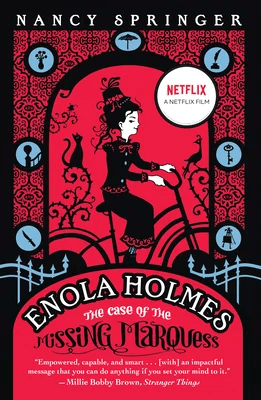
THE CASE OF THE MISSING MARQUESS by Nancy Springer
I am an affiliate of Bookshop.org and Libro.fm, online retailers that support independent booksellers. If you make a purchase by clicking through the links in this post, I will receive a commission. For more information, see my “About” page.
On her fourteenth birthday, Enola Holmes discovers that her eccentric mother has vanished. Even her older brother Sherlock cannot find the marquess. As her eldest brother, Mycroft, makes plans to send her away to boarding school, Enola discovers a series of clues that her mother left specifically for her, and she begins to realize that the mystery may not be quite what it seems. Her investigation and her desire to avoid boarding school at all costs prompt Enola to flee from her brothers and seek refuge in the city of London. With the help of her analytical mind and her gift for disguise–traits which she shares with her brother Sherlock–Enola is determined to solve the mystery of her mother’s disappearance and any other mysteries she stumbles across along the way. And nothing–especially not her being a girl–will stand in her way.
Springer builds a vivid and detailed picture of life in Victorian London, the poverty of the East End, and the challenges of being a woman in the nineteenth century. Add a brilliant, snarky narrator, hilarious disguises, codes to crack, clues to unravel, and the indomitable Sherlock Holmes as a rival and adversary and you have one of my favorite children’s mystery books! The only down side to this wonderful mystery series is that its reading level is a bit more difficult than its interest level. It is best for advanced upper elementary readers, (possibly also middle school readers) and will probably be of most interest to girls. I highly recommend it!
Five books follow The Case of the Missing Marquess in the Enola Holmes series:
2. The Case of the Left-Handed Lady
3. The Case of the Bizarre Bouquet
4. The Case of the Peculiar Pink Fan
5. The Case of the Cryptic Crinoline
6. The Case of the Gypsy Goodbye
THE INVENTION OF HUGO CABRET by Brian Selznick
I am an affiliate of Bookshop.org and Libro.fm, online retailers that support independent booksellers. If you make a purchase by clicking through the links in this post, I will receive a commission. For more information, see my “About” page.
When Hugo’s father perished in a fire, Uncle Claude took Hugo into his apartment in the train station and taught him how to care for the clocks. Now that Uncle Claude has disappeared, Hugo takes care of the clocks himself, hiding in the walls of the train station, stealing food when he can, and avoiding the Station Inspector. As soon as the clocks have been tended to, Hugo turns back to the secret project that keeps him going: the automaton man at the writing desk that Hugo’s father had been repairing when he died. Hugo is sure that if he can fix the automaton, the mechanical man will write a message from his father. Using his father’s notebook as a guide, he steals toys from the station toy booth and uses their parts to replace the missing and broken pieces. But one day, the toy maker catches him. When he sees Hugo’s notebook, he seems horrified and confiscates it immediately. Although Hugo follows him to his house, he cannot convince the toy maker to give it back. But he does meet Isabelle, the toy maker’s goddaughter, who seems to have secrets of her own. Together, she and Hugo try to get the notebook back and to decipher the automaton’s mysterious message.
This book has a very interesting premise that was inspired by a true story. It is told in words and pictures, switching back and forth between pages of prose and full-page drawings. As you discover later in the book, the format is very intentional for this particular story. I found it a bit challenging to get into because the transition between words and pictures was somewhat jarring (very different from reading a graphic novel!). But once I got into the rhythm, and deeper into the story, I was grateful for the story-telling images. The book deserves its Caldecott Medal.

- ← Previous
- 1
- 2
- 3
 Susan the Librarian