
YA Science
THE WOMAN ALL SPIES FEAR by Amy Butler Greenfield
I am an affiliate of Bookshop.org and Libro.fm, online retailers that support independent booksellers. If you make a purchase by clicking through the links in this post, I will receive a commission. For more information, see my “About” page.
I received an Advance Reader Copy of this book from the publisher in order to write this review.
When Elizebeth Smith accepted a job studying Shakespeare’s First Folio on a wealthy man’s estate, her primary motivation was to escape her domineering father’s household. But this unusual opportunity would set her life on a new and unexpected course. On the estate, she met fellow employee William Friedman and the two began collaborating on code breaking projects. Their partnership would become both professional and romantic, skyrocketing them both into positions as elite cryptanalysts for the United States government. Though William would become famous for heading the team that cracked the Japanese code machine “Purple” and for his role in the fledgeling NSA, Elizebeth’s contributions to her country were less celebrated and in some cases attributed to others–men, of course. But Elizebeth’s incredible work not only saved American lives in both World Wars but broke down barriers for women in intelligence work and pushed the boundaries of code breaking.
Spanning two wars and featuring colorful characters from eccentric millionaires to rumrunning gangsters, this true story at times feels like fiction. Though marketed to teens, adults will enjoy this fascinating biography just as much as younger readers. Greenfield is honest about holes in the historical record but still manages to uncover enough information to piece together a cohesive picture of Friedman’s secretive life and contribution to counterintelligence. Bits of code included in the text along with instructions for deciphering it add a beautiful interactive element to the book. I highly recommend this one to teens and adults alike!

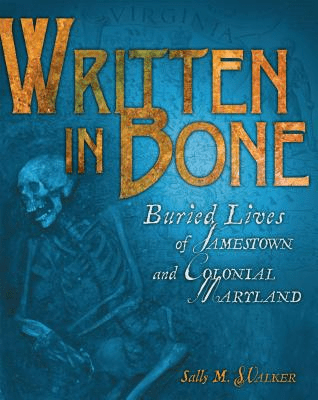
WRITTEN IN BONE: BURIED LIVES OF JAMESTOWN AND COLONIAL MARYLAND by Sally M. Walker
I am an affiliate of Bookshop.org and Libro.fm, online retailers that support independent booksellers. If you make a purchase by clicking through the links in this post, I will receive a commission. For more information, see my “About” page.
Skeletons speak to forensic anthropologists, the scientists who study the bones found in archaeological digs. Simply from looking at bones which have spent hundreds of years buried underground, forensic anthropologists can determine the age, sex, race, and sometimes even profession of the person to whom they belonged. By comparing to historical records the information gleaned from the bones, they may even be able to pinpoint the skeleton’s name.
Sally M. Walker describes archaeological digs in Colonial Virginia and Maryland that uncovered a number of graves from the 17th and 18th centuries. She frames her story almost as a mystery, as the scientists seek to uncover the identity of the person whose bones they have rediscovered, and she describes both the science and the history that surround their process. Written in Bone is a fascinating and engaging nonfiction story. I highly recommend this book to middle grade and teen readers who enjoy science and/or history.
If you liked Written in Bone, you might like Phineas Gage: a Gruesome But True Story About Brain Science or Extreme Scientists.
PHINEAS GAGE: A GRUESOME BUT TRUE STORY ABOUT BRAIN SCIENCE by John Fleischman
I am an affiliate of Bookshop.org and Libro.fm, online retailers that support independent booksellers. If you make a purchase by clicking through the links in this post, I will receive a commission. For more information, see my “About” page.
In 1848, a railroad worker named Phineas Gage was in a horrible explosion that drove a 3.5 foot long, thirteen pound, spear-like iron rod through his skull and brain–and he survived! He never even lost consciousness. For eleven years after his accident, Phineas Gage was a marvel of human physiology and taught doctors an enormous amount about the brain. John Fleischman’s book tells the story of Phineas Gage’s accident in all of its gory detail and then traces the scientific explanations of his survival and the personality changes that happened after his accident, as well as how his case influenced the history of neuroscience. This book will be most interesting to middle and high-schoolers, especially those interested in science, but also has a strong “strange-but-true” and grossness factor. Even upper elementary-schoolers who enjoy the Guinness Book of World Records and Ripley’s Believe It Or Not books will enjoy the first chapter of this book (the story of the accident) and all of the cool photos and illustrations. This book is fascinating! I highly recommend it!
If you liked Phineas Gage, you might like Written in Bone: Buried Lives of Jamestown and Colonial Maryland or Extreme Scientists.

 Susan the Librarian