
Young Adult
THE HOBBIT, OR THERE AND BACK AGAIN by J.R.R. Tolkien
I am an affiliate of Bookshop.org and Libro.fm, online retailers that support independent booksellers. If you make a purchase by clicking through the links in this post, I will receive a commission. For more information, see my “About” page.
Bilbo Baggins was a polite and respectable hobbit who lived in a neat little hobbit-hole in the Shire and never, ever did anything unexpected. That is, until the wizard Gandalf the Grey and a company of thirteen dwarves show up on his doorstep and suddenly sweep him off on an adventure. The dwarves have been wandering for years since their home under the Lonely Mountain was conquered by Smaug the dragon. Thorin Oakenshield believes the time is right to lead his followers back to the mountain and reclaim his grandfather’s treasure. For reasons he does not fully explain, Gandalf has chosen Bilbo as the “burglar” who will help the dwarves reclaim their home (although poor Bilbo has never stolen anything in his life). The quest begins with unfortunate encounters with mountain trolls and goblins, and Bilbo worries that he may not be cut out for adventuring after all. But when a misadventure in the Misty Mountains leads him to discover a magical ring, Bilbo’s luck turns for the better, and he may become a successful burglar at last.
Tolkien’s classic precursor to the Lord of the Rings trilogy is truly a children’s book–lighthearted and full of adventure, humor, and magic. Elementary-age readers who enjoy fantasy such as Harry Potter or the Redwall books will love The Hobbit, although younger or less skilled readers may prefer it as a family read-aloud since it is not an easy text. It is an engaging book, however, and many reluctant readers find that the story motivates them to read it again and again despite the initial struggle.
If you liked The Hobbit, you may also enjoy The Miraculous Journey of Edward Tulane, Charmed Life, The Secret of Platform 13, Magyk, Peter Pan, Peter and the Starcatchers, Gregor the Overlander, and Redwall.

WRITTEN IN BONE: BURIED LIVES OF JAMESTOWN AND COLONIAL MARYLAND by Sally M. Walker
I am an affiliate of Bookshop.org and Libro.fm, online retailers that support independent booksellers. If you make a purchase by clicking through the links in this post, I will receive a commission. For more information, see my “About” page.
Skeletons speak to forensic anthropologists, the scientists who study the bones found in archaeological digs. Simply from looking at bones which have spent hundreds of years buried underground, forensic anthropologists can determine the age, sex, race, and sometimes even profession of the person to whom they belonged. By comparing to historical records the information gleaned from the bones, they may even be able to pinpoint the skeleton’s name.
Sally M. Walker describes archaeological digs in Colonial Virginia and Maryland that uncovered a number of graves from the 17th and 18th centuries. She frames her story almost as a mystery, as the scientists seek to uncover the identity of the person whose bones they have rediscovered, and she describes both the science and the history that surround their process. Written in Bone is a fascinating and engaging nonfiction story. I highly recommend this book to middle grade and teen readers who enjoy science and/or history.
If you liked Written in Bone, you might like Phineas Gage: a Gruesome But True Story About Brain Science or Extreme Scientists.
THE WESTING GAME by Ellen Raskin
I am an affiliate of Bookshop.org and Libro.fm, online retailers that support independent booksellers. If you make a purchase by clicking through the links in this post, I will receive a commission. For more information, see my “About” page.
Sixteen seemingly unconnected people are invited to live in Sunset Towers, a strange apartment building with the West wall made solely of window glass, looking out toward the beautiful sunsets and millionaire Samuel Westing’s old mansion. But when several of the children sneak into the Westing house on a dare and discover the millionaire’s dead body, the sixteen strangers learn that they are not unconnected after all. They are all named as heirs in Samuel Westing’s will. The will itself, however, is unconventional to say the least. It claims that Samuel Westing was murdered by someone in Sunset Towers and challenges the heirs to find the murderer in order to inherit the $200 million fortune that Westing left behind. The heirs divide into eight teams, and each team receives a different clue. Now the race is on to discover who killed Samuel Westing and nab the $200 million before the mysterious killer strikes again.
Anyone who enjoys the Thirty-Nine Clues series should check out this 1979 Newbery Award winner. Although similar in plot, however, the style could not be more different. Sixteen eccentric characters compete in a bizarre and confusing game that will keep the reader as invested as the characters in puzzling it out. Ultimately, however, the point of the story is not the murder mystery but the development of the characters individually and as a community.
If you liked The Westing Game, try The Mixed-Up Files of Mrs. Basil E. Frankweiler. If you enjoyed the somewhat eccentric characters, you may also enjoy A Wrinkle in Time and Saffy’s Angel.

MISS PEREGRINE’S HOME FOR PECULIAR CHILDREN by Ransom Riggs
I am an affiliate of Bookshop.org and Libro.fm, online retailers that support independent booksellers. If you make a purchase by clicking through the links in this post, I will receive a commission. For more information, see my “About” page.
When Jacob was a young child, he believed his grandfather’s stories about growing up in Miss Peregrine’s Home for Peculiar Children and fighting monsters. He believed that the photographs of the flying girl, the invisible boy, and his grandfather’s other peculiar playmates were all real. By age 16, however, Jacob has grown to understand that the photographs are fake and his grandfather’s stories merely fantasies invented to mask the horrible reality of growing up in Poland and being hunted by human monsters, the Nazis. But when Jacob finds his grandfather dead in the woods, he has to admit that either he is going crazy or the tentacled creature he saw slithering away from his grandfather’s bleeding body was no fairytale. Finding a letter from Miss Peregrine in his grandfather’s study, Jacob travels to England in search of the Home for Peculiar Children, all too aware that if Miss Peregrine is real, the monsters must be real too.
I absolutely loved this book. From its beginnings playing with the blurred lines between true horrors and fantastical horrors to the full-fledged fantasy of Miss Peregrine and her wards and through all of the photographs in between, the book was fascinating and fast paced. I couldn’t put it down. Unfortunately, the ending was not as strong as the beginning and middle. It was clumsy and poorly timed, and instead of providing the cliff-hanger incentive to read a sequel that the author intended, it just seemed awkward and dissatisfying. If only he had ended it about a page earlier! But I hope that the poor ending will be remedied by the sequel that is promised for 2013. For that reason, I will give this book a strange recommendation: I highly recommend reading it, but if you are picky about endings like I am, you may want to wait to read it until the sequel is released to avoid an awkward interruption in the action.
INCARCERON by Catherine Fisher
Finn has never known any world except Incarceron. He was born in a cell, with one of the red eyes of the prison staring at him, mocking him. Some prisoners, like his blood brother Keiro, don’t believe that there is a world outside of the prison. But Finn believes, and he is determined to escape–even though the prison itself is alive and determined to stop him. When the violent prison tribe to which Finn belongs kidnaps a woman from a more peaceful tribe, Finn finally has the opportunity to learn something of his past and to gain a crystal key that may somehow unlock the prison. Through the key, he finds that he can communicate with a girl on the outside called Claudia, daughter of the warden of Incarceron. Claudia is betrothed to the heir to the throne in her own world, but she is really just a pawn in a political game between her father and the queen. But when she gets in touch with Finn and realizes that Incarceron is not a utopia as the government claims, she also begins to discover more dark secrets behind the throne. In order to unravel these secrets, Claudia must find a way to rescue Finn from Incarceron before her wedding day arrives.
Somewhere between science fiction and fantasy, Catherine Fisher’s dark dystopia will likely appeal to teens who enjoyed series like The Hunger Games and The Looking Glass Wars. The storytelling is gritty and fast-paced and the world of the prison is intricately imagined. Incarceron is followed by a sequel, Sapphique.
DOES MY HEAD LOOK BIG IN THIS? by Randa Abdel-Fattah
I am an affiliate of Bookshop.org and Libro.fm, online retailers that support independent booksellers. If you make a purchase by clicking through the links in this post, I will receive a commission. For more information, see my “About” page.
When Amal makes the decision to wear the hijab full time, she knows that some people will support her–her friends from her old Muslim private school, for example, and even some close friends from her new Catholic school. But from everyone else, she is prepared for the worst: the stares, the ridicule, the assumptions that she is a terrorist or an oppressed woman forced into submission by an anti-feminist culture, etc. What she doesn’t anticipate is the sense of freedom, confidence, and identity that comes from wearing the hijab. As Amal continues to navigate the many stresses of high school–parental pressures, bullying at school, and a crush on a wonderful boy who may or may not share her affections–she learns more about herself, her personal and cultural identity, and the diverse cultural identities of her friends and neighbors.
Amal is a fun, snarky, and genuine narrator who realistically captures the common experiences of the typical teenage girl while also providing a window into a culture that may be unfamiliar to some readers. This book would be a tough sell for boys, but teen girls who enjoy realistic fiction should definitely check this one out!

SPEAK by Laurie Halse Anderson
I am an affiliate of Bookshop.org and Libro.fm, online retailers that support independent booksellers. If you make a purchase by clicking through the links in this post, I will receive a commission. For more information, see my “About” page.
High school has very defined social rules. Most of them are comical. People divide into cliques that all have absurd dress codes and behavior expectations. Everyone is supposed to be incredibly enthusiastic about the school’s crappy sports teams and the mascot that seems to change every other day. Melinda can see the absurdity of the high school social environment because she is an outsider. She has no clique. She has no friends. The people who used to be her friends will barely even look at her after what happened at the party over the summer. It had been Melinda who called 911, but not because of the drinking. She called because of what happened to her outside, that no one knows about except her and the boy she now thinks of as “It.” Melinda has not told anyone what happened; she doesn’t say much of anything anymore. Her grades are slipping, attempts at friendship failing, and even the desire to have friends seems to be slipping away. Only something about art class still seems compelling to her, though she isn’t much of an artist. As her parents and teachers get increasingly frustrated and concerned, Melinda struggles to navigate the rules of high school and to find a way to express what happened over the summer.
Melinda is a wonderful narrator. Her observations about the high school world are snarky and 100% accurate. You may not expect to laugh at a book with as heavy subject matter as this one, but Speak is about more than just rape. This incredibly well-written and nuanced novel will be accessible to anyone who is or has ever been in high school, and Melinda’s journey toward finding her voice is a powerful one. The subject matter is heavy (though not graphic) and may be upsetting to some readers, so use your judgment. But this is one of my favorites–possibly because Melinda and I have a very similar sense of humor and reaction to high school.

A WRINKLE IN TIME by Madeleine L’Engle
I am an affiliate of Bookshop.org and Libro.fm, online retailers that support independent booksellers. If you make a purchase by clicking through the links in this post, I will receive a commission. For more information, see my “About” page.
Meg tends to get into trouble at school. She’s very stubborn and quick-tempered, and although she’s brilliant at math, she can’t seem to complete the work the way her teachers want her to. Most of the fights she gets into with her peers revolve around defending her little brother Charles Wallace from accusations of being stupid or different–and around defending her firm belief that her father is coming back. Although he’s been gone for years on a secret mission for the government and they’ve had no contact, Meg, her brilliant scientist mother, and Charles Wallace (who is, in fact, the most brilliant of them all) are convinced that he is coming back. But what Meg does not expect is that one stormy night, three mysterious old women will whisk her, Charles Wallace, and their neighbor Calvin off the face of the Earth, to some distant planet where their father has been fighting an evil darkness that threatens to engulf the universe. Now, her father is imprisoned, and it is up to the three children to rescue him before the darkness overwhelms his soul.
This year marks the fiftieth anniversary of this classic children’s book’s release. A Wrinkle in Time is not just a great sci-fi novel. It explores themes of love and family, the balance between independence and relying on a parent, and the coexistence of courage and fear. This is a great coming-of-age novel that starts a fantastic sci-fi series. I highly recommend it to children and to teens!
If you like the eccentric characters, check out Saffy’s Angel and The Westing Game.
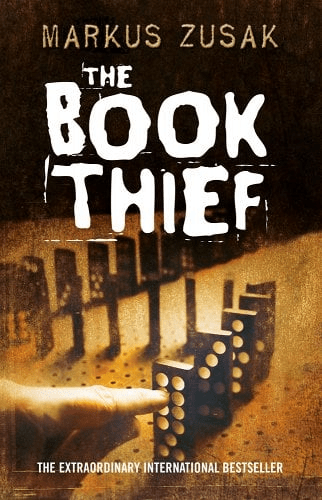
THE BOOK THIEF by Markus Zusak
I am an affiliate of Bookshop.org and Libro.fm, online retailers that support independent booksellers. If you make a purchase by clicking through the links in this post, I will receive a commission. For more information, see my “About” page.
The first time Death met Liesel Meminger, the book thief, she was on a train with her mother and her little brother, traveling to a foster home near Munich where the children could escape the shadow of their father’s identity as a Kommunist. It was the little brother’s soul that Death had come to collect. As he cradled the little boy’s soul in his arms and watched the living grieve, Death did not know that he would meet the book thief two more times during her childhood, nor that he would find her journal in the wreckage of a bomb-torn city and would read it again and again, memorizing her story and always carrying it with him. He shares Liesel’s story with the readers in his own way–recounting the mischief she concocts with Rudy Steiner, the complicated but ultimately loving relationships in her foster family, the struggle of learning to read, poverty and hunger in the Third Reich, the terrifying business of hiding a Jew and the powerful friendship that results from it, the complex intertwining of patriotism, loyalty, and morality–all over-layed with Death’s observations of the tragedy of war and the enduring hope and beauty of life.
Ultimately, it is the words—of the author, of the characters, of the past—that bring the story to life so vibrantly and unforgettably. This is a book to be savored. It is at once heartbreaking and heartwarming. There are no real plot twists; Death tells you the ending at the beginning. The book is about the journey of the characters and their complex, beautiful relationships. Zusak does not neglect even the minor characters, making them all irresistibly complicated and human. I warn you, you will fall in love with characters in this book, and their stories will stay with you–as they did for the narrator, Death. Your heart will likely break at some of the tragedies they endure. But it is worth it for the journey you share with them, just as Death demonstrates that even the shortest lives captured in Liesel’s journal have profound and enduring beauty and meaning. The Book Thief has been my Favorite Book Of All Time since I first read it in 2006, and it will take an extraordinary book to ever supplant it in my affection. I cannot recommend it highly enough for teens and for adults.
If you liked The Book Thief for its themes and characters, you might like The Fault In Our Stars by John Green.
If you liked The Book Thief for its subject matter and narrative style, you might like Slaughterhouse-Five by Kurt Vonnegut.
THE FAULT IN OUR STARS by John Green
I am an affiliate of Bookshop.org and Libro.fm, online retailers that support independent booksellers. If you make a purchase by clicking through the links in this post, I will receive a commission. For more information, see my “About” page.
Hazel does not particularly enjoy support group. It consists of sitting in a church with a bunch of other teenagers with cancer of various kinds at various stages, all in the process of dying–even those in remission. All humans are in the process of dying, after all. But it is at support group that she first meets Augustus Waters, an incredibly attractive guy with an unrelenting wit and an affinity for metaphorical cigarettes. Their friendship forms quickly around conversations about nuances of language, action movies, video games, and in particular a somewhat philosophical novel by a reclusive author. Peter Van Houten’s novel has had a profound influence on Hazel and her worldview, but there is one problem. It ends mid-sentence with the main character’s death. Not a very satisfying conclusion. As Hazel tries to balance her feelings for Augustus with her reluctance to begin a relationship that must inevitably soon end with her death, Augustus tries to track down Van Houten to find out how the novel ends.
The Fault in Our Stars is at once hilarious and heartbreaking. Through an exploration of love, family, hope, disappointment, and loss, John Green captures the infinite beauty, tragedy, and potential of finite human life. Hazel and Augustus are witty, intelligent, imperfect, and so utterly human that I could not help but fall in love with them. Although it is heart-wrenching, I would not call this book depressing. In fact, I would describe it as uplifting, a reminder that the transience of human life does not diminish its beauty or its meaningfulness. Thank you for this book, John Green. It is truly a masterpiece.
If you liked The Fault in Our Stars, you might like The Book Thief by Markus Zusak.

 Susan the Librarian